
Recognising the sacred
Betty Stroud
Year C 2025 Pentecost 11
Jeremiah 1:4-10 and Luke 13:10-17
There are places I’ve been where earth and heaven seem to touch one another, where the gap between them is tissue thin. I call those places sacred places.
Places can be sacred. Objects can be sacred. Times can be sacred. People can be sacred. Music can be sacred. Works of art can be sacred. But what do we mean when we say that something is sacred?
For me, it means that somehow, it bears the marks of God. That it has a quality about it that enables us to sense the presence of God or feel connected to God in some way.
The sacred, for me, means a space where earth and heaven seem to kiss; where reality becomes transparent and I can see right through to things far deeper and more mysterious.
We encounter the sacred in all sorts of times and places, and more often than not its unexpected. I imagine that you, like me, have experienced sacred moments, or at least moments where you’ve caught a fleeting glimpse of the sacred. It might have been walking on a beach. It might have been witnessing the birth of a baby, or even the hatching of an egg. It might have been opening a letter that says “I’m sorry” from someone you’d given up hope of hearing from again. It might have been taking a walk in a forest and just touching the trunk of a large, old tree.
These are moments when, however fleetingly, it becomes suddenly clear to us that there is more to life than shopping and watching television. When suddenly the universe itself is pulsating with light and life, the air is fragrant, and we are caught up in the preciousness and mystery of life.
We sometimes think that encountering the sacred doesn’t happen that often, but I believe the sacred is all around us: in every sight we see, in every place we go, in every creature we meet, in everything we touch. All of creation is infused with the presence of God. Everything that lives, lives because of the life breath of God within it. Everything we encounter is capable of being sacramental, of being that window through which we see the sacred.
This question of the nature of the sacred is an issue in the readings from Jeremiah and Luke. In the story from Luke’s gospel we saw what happens when somebody tries to control the sacred – and I’ll talk about that a bit later.
But first, let’s look at Jeremiah: Jeremiah wasn’t blind to the sacred presence of God all around him, but he did start out with a somewhat limited view of its extent. The story we heard is the first story in the account of Jeremiah, the story of God calling him to be a prophet.
Jeremiah starts out by protesting the inappropriateness of God’s choice. “I’m not up to the job. I don’t know how to speak. I am only a boy.” But God says to him, “Before I formed you in the womb I knew you, and before you were born I consecrated you.” In other words, God was saying, I made you sacred.
Now that is not unique to Jeremiah. That’s all of us – for I believe that within us, there is God. Within us there is all the potential to be Christ-like, to be God-like, and to bring to fullness in our own beings, the essence of the holy God who is love.
Just as God proclaimed Jeremiah to be sacred, so too, God proclaims us to be sacred beings – bearers of God.
Of course, we can drag our sacredness through the mud, we can do your best to tarnish it. Everyone from a kid making racist taunts in the school yard all the way up to the President of the United States is capable of dragging their sacredness through the muck.
Or, we can, like Jeremiah protest. We might not say, ‘I am only a boy’, but we make other excuses. Excuses such as: ‘I’m not good enough’, ‘I don’t have an education’, ‘I don’t have this or that skillset’, and so the list goes on.
But God sees within us, the people who God made us to be: people created to enter so fully into relationship with God that we are in fact drawn into the very being of God, which means that we will be in God, and God will be in us to such an extent, that we become real embodiments and expressions of God’s own being.
The sacred is all around us, in every place, in every moment. And the sacred is always within us, calling us to embrace our God given destiny – which is to be sacred bearers of God in a sacred world.
The question of the nature of the sacred is also in our story from Luke’s gospel
In that story we see what happens when somebody tries to control the sacred. Tries to regulate it, to guard it, and restrict access to it.
The leader of the synagogue, a man to whom the handling of sacred things has been entrusted, has so lost his ability to see beyond the externals of things that even the most transparently sacred things become mundane objects.
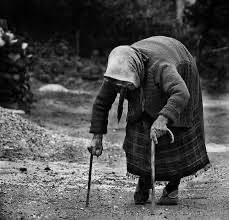
A woman comes into the synagogue, a woman who has been crippled for eighteen years and is bent over, unable to stand up straight. What does the synagogue leader see? Maybe he sees an outcast – for that she certainly would have been. Maybe he sees something grotesque and distorted – something hardly human.
On the other hand, Jesus sees this woman as a person of dignity and worth – a beloved child of God. In short, he sees a sacred being – someone who bears in her very being the image of God. He sees her disability as well, but primarily, he sees her as a sacred bearer of the image of God who just happens to have a disability. Jesus can also see that the disability has marginalised her in the community. He sees it has caused her to be shunned, and thus her sacredness denied. And so, Jesus commits a sacred act. A sacramental act – one of those acts that pulls the veil back and allows us to see, for a moment, the reality of God that permeates the world. He heals her and says, “Woman, you are free.”
But the synagogue leader, not able to see the sacredness of the woman and not able to see the sacredness of healing, is indignant. This breaks the rules. This is not allowed. There are times and places for these things and this is neither the time or the place. It’s the Sabbath, a sacred day and they’re in the synagogue! So, what does he say?
You can’t do that sort of thing here – it’s not an appropriate day!
Talk about missing the boat! What could be more appropriate than a sacred action for a sacred being on a sacred day. A person is set free, and the liberation is regarded as work, and not the shalom for which people hunger. As we frequently experience in the Jesus stories, the wonder of healing and restoration is less pronounced than the reaction of crowds and clergy. In so many of the Jesus stories we hear the crowds murmur words of disapproval, and synagogue leaders criticise as people crippled with possessions are set free, and tax collectors reimburse their victims. A blind man cries out to Jesus, and the crowd seeks to jostle him into silence. The criticisers and naysayers see little of the sacred – either in Jesus’ actions, or the people he sets free.
We might ask ourselves, ‘How often are we blind to the sacredness of the other?
Take a moment to think about it.
Or perhaps another question: ‘Do we contribute to the condition of those who are bent over so far, they can see barely more than a pace in front of their eyes?’
Again, take a moment to think about this.
For Jesus, the worth – or the sacredness of this woman, was not measured in her abilities, or lack of them, nor was it measured by her disability. For Jesus, this woman was a child of Abraham, an inheritor of the promise of God: her sacredness was her humanness.
And it is the same for each one of us. We are beloved children of God – people who hold within us the sacredness of the God who loves us.
Not only that, our calling is to help people lift their heads and receive the blessing of freedom and know they are sacred in our eyes and in the eyes of God.

