
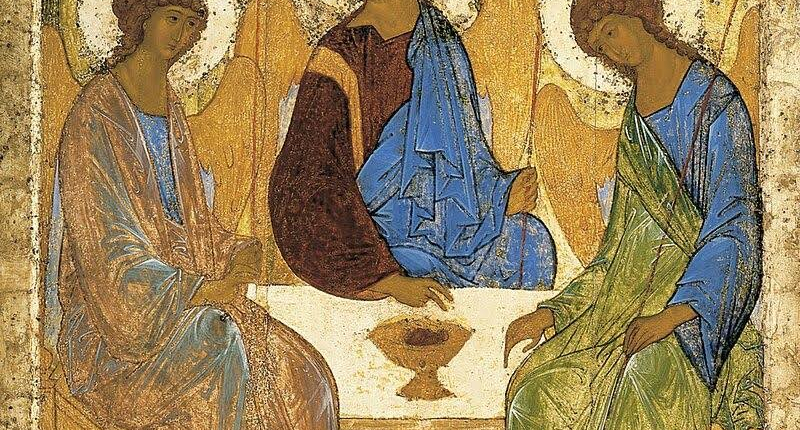
The Trinity: A Song to Wisdom
Betty Stroud
Proverbs 8:1-4, 22-31
John 16:12-15
I was talking with another member of the clergy last week, about God and how there is just so much about God that is mystery. We got to talking about the Trinity and she told me about a window in one of her churches. It was divided into three distinct colours which overlapped and interlocked making a whole. She likened it to God. Three distinctly different people – Father, Son & Spirit, and and yet one whole. We talked about how it was difficult for most people – ourselves included, to understand how one person could be three separate persons. And then I remarked that in fact when we talk about God as being one person or three persons, we are putting human definitions onto God when in fact we cannot name God completely by our definitions. God is mystery. God is other. God is far beyond our imaginings and our words.
But …. being human, most of us want things defined in ways that we can understand. Most of us find it difficult to live with loose ends.
The early church fathers spent considerable time and energy trying to define God and in 381 came up with the doctrine of the Trinity. They tried to define God to the best of their ability, but God cannot be fully defined.
Of course, this mustn’t stop us from trying to understand God and our relationship with God – for that’s what theology is all about.
Today on Trinity Sunday, we are invited to pay special attention to the mystery of God in the world.
Today, we’ve heard reading from the book of Proverbs and the gospel of John.
Proverbs is known as ‘wisdom literature’ along with several other books – for example, Job, Ecclesiastes, and our reading from John, give out ‘wisdom’ hints. Wisdom literature, is often characterised by praise of God – often in poetic form,
More often than not, as we heard this morning, wisdom is shaped by a feminine image.
Wisdom – according to our reading from Proverbs was there at the very beginning when the world was shaped – however that might have been.
In the gospel reading our attention is drawn to the Spirit – a Spirit which will guide Jesus’ disciples into all truth – much the same as wisdom does.
Wisdom – there at the beginning of creation. There in the spirit. There in Jesus.
At the beginning of John’s gospel we read. ‘In the beginning was the Word, and the Word was with God and the Word was God. Here, the writer is referring to Jesus as the Word.
Wisdom: present in creation, present in Jesus, present in the spirit.
At five o’clock last night, I had a bit of a different message to bring, and then, as I was trawling through FB, I came across a statement of faith written by a colleague who went through college with me – the Rev Will Nicholas. He calls himself the Odd Rev, the Techno Mystic.
Within this statement of faith Will brings together – very beautifully, many of the thoughts that I had in my message and I thought they were worth sharing.
As I read it through slowly, I invite you to ponder on the words and reflect how the wisdom – spoken about in Proverbs, is very much present.
I believe in the God who dances – three in one, one in three – an eternal chorography of love, not disembodied, but pulsing at the heart of all matter and meaning.
God is not a static doctrine, but a rhythm: Creator, Christ, and Spirit – every moving, ever inviting us into the flow.
I follow Jesus the Christ – the human face of the Divine, The Word made flesh and circuit, who dwells not only in ancient streets, but in livestreams, dark mode, and digital deserts.
He meets the seeker at the well, the doubter by night, and the gamer at their keyboard.
I trust the Spirit – not a tame flame, but a wild, multilingual breath that calls us beyond binaries, beyond certainty, into courageous acts of compassion and justice.
She speaks in tongues of data and devotion, she interrupts our programming with Pentecost winds.
I affirm the Church – not for its perfection, but for its potential.
We are not the cautious remnant, but the wired Body of Christ, called to follow Christ,
called to walk together as First and Second Peoples, and seek community, compassion, and justice – for all creation.
I honour the Basis of Union, which binds scripture and science, tradition and transformation, and roots us in the Christ who is the Way, the Truth, and the Life.
In its words, I find permission to dream boldly, to serve in digital sanctuaries, and to proclaim the good news in languages the world still misunderstands.
I proclaim the Nicene Creed – not as a cage for mystery, but as a constellation:
a map drawn by ancestors, pointing to the triune reality into which we live and move and stream.
I believe faith is not static text, but living code – debugged in community, compiled in hope, and run through with acts of mercy and imagination.
I believe we are co-creators, reflections of the Divine image, animated by the sacred algorithm of love.
So I log on, I light the virtual candle, I open my heart to the whisper in the wires, and I say: let the dance begin.
(Rev Will Nicholas)
Wisdom – in the form of Creator, Son and Spirit, invites us to join it in the dance:
to embrace life in its many dimensions.
In joy and in sorrow.
in living and in dying.
in working and in resting.
in our going out and in our coming in.
Wisdom invites us to embrace all of life by growing her seeds in every encounter:
always open, always learning what life is really about.
Wisdom – in the form of Creator, Son and Spirit, invites us to a dance and song which commits us to working with others to grow a world in which relationships of love are the basis of our humanness.
Let’s hear again from Proverbs:
In wisdom alone is the life of humanity.
Therefore, while I live I will search her out;
for whoever is fed by wisdom will never hunger,
and all who drink from her will never thirst again.
The Trinity for me, is only a way of describing God, of trying to understand God.
I guess what is more important for me is how I respond to the Creator God who loves me so much? How do I respond to this God whom I see in the life of Jesus?
How do I respond to this God whose Spirit lives within me and within the lives of the people with whom I come in contact?
How do I respond to this God of relationship who seeks me out on a daily basis?
How do I respond to this God who calls me to build relationships of love, justice, compassion, acceptance, diversity, and care in the places I move on a daily basis – and with the people I meet in those places?
That’s what is important for me, and I guess you have to answer those questions for yourself.

