
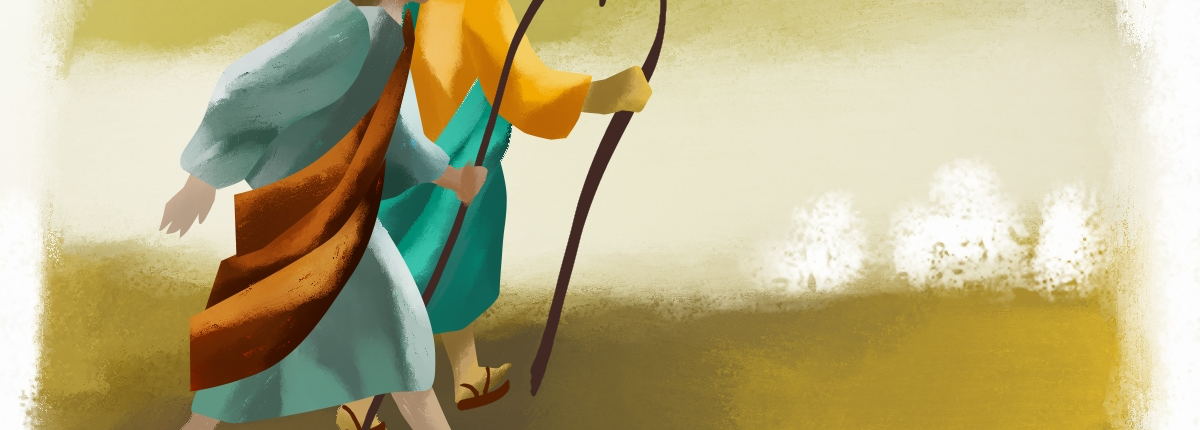
Going on a Journey
Betty Stroud
Year C 2025 Pentecost 4
Luke 10:1-11, 16-20
Hi! My name is Joel. I’m one of the seventy that you heard about in the reading from Luke. Did the reading seem strange to you? Were you able to understand it? As I have been listening to it I must say that if I hadn’t been part of the experience I would find it difficult to understand.
And so, to make it easier for you, I want to take you back nearly 2000 years. Settle back comfortably – but not so comfortably that you go to sleep, and put your imaginations to work. Imagine that you are in First Century Palestine.
You and I are sitting on a grassy bank outside one of the villages of Samaria. We’ve chosen this bank because the sun is shining and it’s a great day to be outside, and I want to tell you about some of my experiences over the past couple of weeks.
Jesus, and a group of us have been making our way to Jerusalem. We, his followers, don’t really want him to go because we think it might be dangerous. But he’s fairly insistent. So, because we have decided to follow where he leads we’re going there too.
We’d stopped at a small village for some rest and refreshment. Jesus said to us, ‘You need some practical experience about what it means to be a follower of mine. I want you to choose a partner and then you are to go to a village and see which householder will invite you in to eat and sleep with his family.
There were seventy of us that he chose and we were all allotted a village. and Joshua – a very good friend of mine – was paired with me.
Jesus told us we would be like lambs in the midst of wolves – well … we didn’t want to think about that too much! Rather, we looked upon it as a new adventure. Here was our opportunity to prove ourselves. To show others what we stood for. To tell others about Jesus and what a difference he had made to our lives. Jesus also told us to cure any sick people. That in itself was a challenge – would we be able to? Joshua and I talked about these things as we walked along and decided we needed to do some serious praying.
Challenging too, was the fact that we were totally dependent on the hospitality of others – for we were to take nothing with us! Now we Palestinians are always hospitable to those who seem to have a genuine need for food and a bed for the night. It’s built into our culture – it’s one of the things that we do well. But ….. would we be welcomed?
As we walked towards the village of Amnath, Joshua said to me, ‘What if they don’t think we’re genuine? What if they don’t welcome us? What are we going to do then?
As we walked into the courtyard of the house we had chosen, Joshua was still going on about being turned away by the householder. I told him to keep quiet and just act naturally.
There were about a ten people in the courtyard. It was mid-afternoon. The sun had quite a sting in it and it beat down on our heads. We were glad to find there was a shady tree, and we made our way across to it. A man came towards us saying, ‘I can see that you’re hot and dusty. Can I offer you refreshment?
I breathed a sigh of relief. It was going to be alright.
The man, whose name was Simon, was the head of the household. He called for water with which we could wash our hands and bathe our aching feet
The slaves brought out bowls, and jars of cool, clear water. It was bliss as we splashed it over our dusty, feet.
When Simon saw we had finished our ablutions, he called for wine to be brought. It slipped easily down my throat, bringing instant relief He joined us and we began to chat. Naturally he wanted to know where we had come from and where we were going.
And so we told him about our travels with Jesus. We talked of our experiences along the way. About Jesus curing people and teaching them about things that were important to him. Things like caring for each other. We also told him how Jesus wasn’t concerned about what people thought and that for him, people and their needs were more important than rules. Then we told him how Jesus seemed to be genuinely concerned for the sorts of people who were shunned by society, telling him the story of the Samaritan woman whom Jesus had met at the well outside her town.
We talked on and on until the shadows lengthened and dusk fell. It was that time of day when daylight and shadows merge. When the purple haze of the sky seems to throw its glow over everything. It was a magical time.
Simon asked us if we’d like to stay and share the evening meal with his family and spend the night in their home. We accepted thankfully.
It was a wonderful evening. The food was simple but plentiful. Simon’s family made us feel welcome and conversation flowed freely. It was fairly easy to get to know them and they shared some of the stories of their lives.
They were eager to hear our stories about Jesus and so we talked, ate, talked some more and drank. It’s amazing how food and wine can relax you and make it much easier to share stories. I can see now why Jesus was always going to people’s places to eat!
It was amazing too, how Joshua and I learnt so much and received so much from Simon and his family.
It was well past midnight when we eventually went to bed, tired out and exhausted from our travel and the conversation which enabled us to get to know them and they to know us.
As we undressed and got ready for bed, we talked about the wonderful hospitality we had received. We had not expected to be made so welcome – nor had we expected to receive so much from them.
We left the next morning with a warm sort of feeling pervading our senses and our bodies.
Our fears about being rejected had been groundless. Our tentativeness about sharing our stories of Jesus was overcome. Best of all, I think, was knowing that we were doing something for Jesus.
When we spoke with Jesus later, we related what had happened and how we felt. He made it very clear that whilst we should be glad about what we could do for him, it was more important for us to recognise what God does for us.
When I asked him what he meant he replied ‘Think about what God did for you. Think about the generosity and kindness Simon and his family showed you. Think about what you learnt from them. That was God’s grace and love in evidence.
That made me think hard.
Well … we’ve come to the end of our conversation you and I. The shadows have lengthened across the grassy mound and the sun has lost its warmth. It’s time for me to go indoors. And it’s time for you to return to the 21st century.
So what does this First Century story have to say to us today?
When I was young and our family visited someone’s house – Mum always took something with her as a gift to them. I was told it was common courtesy. It was generally cake, or biscuits, or chocolates. Mum said going empty handed was just plain rude!
That’s one of the first memories that springs to my mind when I read this passage, the idea that you appear at someone’s front door, with empty hands and expecting to be invited in, goes against all I had been taught.
But this passage takes us deeper. This is not a story about afternoon tea or dinner, it’s about staying with people, imposing on their hospitality until the job is done.
Whenever that might be. And when we go, we hope for a welcome – one that lasts beyond the kettle cooling.
What does it mean to arrive in a community, with nothing?
When we have no resources – material or financial – behind which to shelter, we can feel exposed.
On the other hand, with all the resources at our fingertips, we find it difficult to imagine that the only resources required when visiting someone are the mercy of God, our story and ourselves.
This story is an assertion of how God is at work in the world – through us and, frequently, despite us.
When we go into our world – wherever that might be: down the street, to work, or to someone else’s home, we take with us a blessing and a story, the story of our experience with Christ, and what that means for us. The story we need to bring is unadorned, unromantic and as tangible as our handshake. We share hospitality, because conversations happen more easily over a percolator and a pikelet.
We never impose the gospel, but offer it, as a cup of tea is offered. It can be received, or refused, but the gift endures – and may well be remembered some time down the track.
Our world is consumed with those who would impose their will, or their violence upon others, with any number of excuses and rationales. Jesus always chose a different course, and calls us to do the same.
When we consider how we might offer a blessing to our friend, our neighbour, even our enemy, remember that we bring with us an encounter with the reign of God in the world. This is God’s astounding mercy – for us, and for those to whom we offer ourselves, woven into the story of God, at work in the world for which Christ died.

